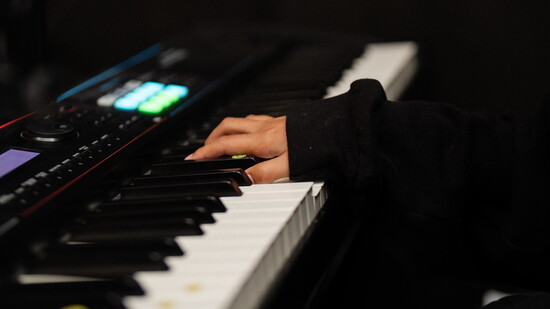
Right inside the front door of School of Rock San Antonio, a wall is covered with photos of kids performing onstage. They’re playing bass, guitar, drums, keyboards, or singing. Some of them are young, and others look like they’re about to graduate from high school. But what they all have in common is that they look like they’re having the time of their lives. Seeing these photos in the lobby while listening to kids laughing and strumming guitars, it’s obvious what is happening at School of Rock: kids are learning to make music while having fun.
School of Rock San Antonio opened in 2012. There are over 350 students there now, from young kids to adults. In 2021, they expanded their space to accommodate the youngest students in the Rookies program, ages 4-8. Those kids participate in a weekly small-group musical discovery lesson. They explore all the rock band instruments and vocals, eventually picking one to focus on. In the Rock 101 and Performance programs for ages 8 and older, students attend a private 30-minute lesson and a 1.5-hour band rehearsal each week. During their lesson, students work on skills for their chosen instrument. Band rehearsals, led by an instructor, bring together four to eight students to learn songs in preparation for one of School of Rock's three annual concerts.
At School of Rock, their main instructional goals are to help kids choose an instrument they’d like to focus on, build their musical skills, and get each band ready to perform in front of a crowd. It is each student’s responsibility to know their part and learn to play it with the band. For a lot of kids, it’s easier to play solo than in a group, so teachers hold band members accountable during rehearsal to point out strengths and areas that need improvement. Owner Michele Patton told me, “It’s like a team. They have to band together, play together, and learn how to communicate.” Music Director David Patton said students are encouraged to work hard so they can see their own improvement and avoid letting themselves or the band down. “We teach real-life expectations. You have to build your way up. You have to learn all your essentials, and then we get to start doing the cool stuff.” One of the opportunities that comes from working hard at School of Rock is the chance to audition for House Band, a group for ages 12-17 that plays gigs all over San Antonio. Auditions are every 6 months, and current members must reaudition to keep their spot. David said, “They have to put the work in other areas for those rewards of stepping to the front of the stage, putting their foot on the monitor, and playing the cool solo.”
School of Rock creates a welcoming environment where students can develop their musical abilities while building confidence, personal growth, and social skills. That all starts with General Manager Renae Patton, who greets everyone by name as they come through the door. There’s also a lounge area where kids can hang out, usually joking with instructors and discussing their favorite bands. Everyone feels comfortable enough to talk freely, laugh loudly, and be themselves. And that is what Michele said is most important to the staff: creating a place where kids feel like they can open up and be themselves.
In group rehearsals, teachers help students get to know one another, making sure they learn everyone’s names and a few things about each other. Instructors are positive and encouraging. They emphasize their goal of learning music together as a group without pushing them too hard. Students are told that when they’re ready, they’re capable of making great music. Michele said, “The world is very demanding. It’s regimented. We’re not. We have rules. But we’re all about respecting everything, and then you have a little bit of freedom in here.” Instructors also know how to adapt when a kid is having a bad day. They give them their space, make them feel welcome, but don’t force them to do anything. As soon as the kids settle in and choose to participate, they realize that making music helps them feel better, and they’re taking charge of their own day. Students come to learn that School of Rock is a place for them to shine, have fun, and do what they can.
With a welcoming and fun environment in place, instructors cultivate supportive relationships between the students. They’re taught it’s a place for encouragement, not for criticism, and that they have a responsibility to treat each other well during rehearsals and performances. When I asked Curly Castillo, one of the drum teachers, about creating an environment where students feel safe taking risks and expressing themselves, he told me it’s a group effort that involves the students. “We work on respecting each other. Communication is one of the main things. If someone’s lost, we don’t yell. We’re like, ‘Yo buddy, come back.’ We communicate.” The instructors at School of Rock have created a sense of camaraderie among the students. The kids want to see everyone succeed.
In addition to the friendships students make at School of Rock, David told me, “The relationship that students build with teachers is really cool.” Unlike in school, where students may only be with their favorite teacher for a year, students can work with and be mentored by their favorite School of Rock instructors for years. And all the staff get to know as many students as possible, so that even when a teacher is out, the kids still get quality instruction and mentorship every day.
On the day I visited School of Rock, a summer camp was wrapping up for the week. The students, a mix of veterans and new kids, had been there for five days, working together to learn new music. They had just finished their live-stream concert, which parents could watch before they picked up their kids. Michele had just been sharing how common it is for students to be shy when they first come to School of Rock, when a parent arrived to pick up their teenager. He told us his kid is ordinarily a nervous person, so he was feeling surprised by their confident performance. Instructor Raul Vela emphasized that the child jumped at the opportunity to sing and did a great job. The father told us how glad he was to see his kid do something outside his element, and that it was very cool to see him perform like that.
Michele told me that every parent at School of Rock hopes their kid will learn more about music and find something they enjoy. But what surprises them is the confidence their kid gains as they make new friends and learn new skills that they apply to other parts of their lives. Parents report that their kids try new things they would never have tried before, like running for Student Government. They’ve also said that their kids used to have a hard time with group work at school or speaking up in class, and now that they’ve built up their self-confidence at School of Rock, those things are coming more easily to them.
At School of Rock, students are taught there’s no such thing as a perfect performance. The instructors tell them to get up there, have fun, and show off what they’ve learned because everyone at School of Rock is already proud of them. Thanks to the positive and encouraging environment they’ve created, it is rare for a student to feel upset after a mistake during a performance. But occasionally, when a student comes off the stage frustrated, it’s their bandmates who are the first to tell them what a great job they did, quickly followed by the entire School of Rock community of instructors and parents. Curly emphasized that there are no rankings or tests there. “Music’s not about competition. It’s about learning a skill that will help you in other subjects, at school, and in critical thinking.”
School of Rock San Antonio is providing excellent music education. They have students who study there for years and go on to form their own bands or go to college to major in music. But Michele told me what makes it a special place is that “We have a lot of kids that actually say this is their second home. And we have parents who tell us their kids think this is their second home.” Many of their long-time students now volunteer to mentor the younger students or help with summer camps. Michele’s favorite part about School of Rock is watching kids grow and improve, especially the ones who were so shy when they first walked through the door. “It brings me so much joy to watch them succeed. I think the transformation, for me, is the most rewarding. Just watching that happen over time, and it does take time. Sometimes it takes a couple of years. But it’s so exciting when it happens.”
We have a lot of kids that actually say this is their second home. And we have parents who tell us their kids think this is their second home.
"It brings me so much joy to watch them succeed. The transformation, for me, is the most rewarding. Just watching that happen over time.
Ready to Rock? Here's the Lineup
School of Rock San Antonio has a program for nearly every age and skill level, so whether your kid is four or fourteen (or you're an adult who never let go of the dream), there's a way in.
Rookies (Ages 4-8): A weekly small-group lesson where the littlest musicians explore every instrument and vocals before choosing their favorite. Pure musical discovery, zero pressure.
Rock 101 & Performance (Ages 8+): Students get a private 30-minute lesson plus a 1.5-hour band rehearsal each week, building skills on their chosen instrument while prepping for one of three annual concerts.
House Band (Ages 12-17): The big leagues. This audition-only group plays gigs all over San Antonio. Auditions happen every six months, and yes, current members have to reaudition to keep their spot.
Adult Programs: Never too late to start. Adults are part of the community too.
With over 350 students and counting, there's room on the stage for everyone.
Want in? Visit School of Rock San Antonio to schedule a tour or trial lesson.