Nobody made them do this.
At nearly every point where an easier option existed, somebody at Redstone American Grill in Maple Grove looked directly at it and went the other way.
The bar.
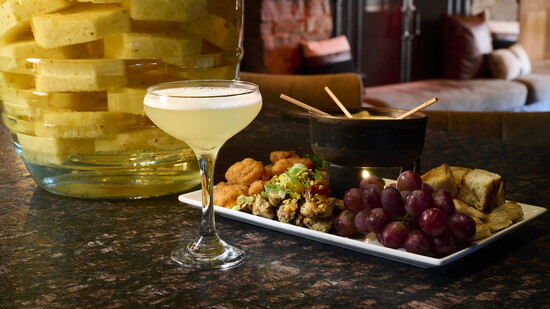
Start at the bar. On the counter in front of you are the barrels: enormous glass vessels packed wall to wall with pineapple.
Twenty-four pineapples fill a single barrel. Kelli Amontroy cut all of them. Plenty of people on the team can build one; she is the one who gets asked. Then she started stacking.
Neatly.
“We start by stacking pineapple neatly into giant jars on our bar top,” she says. It takes a few hours. Nobody will ever see the inside of that barrel — once the vodka goes in and the fruit settles, the arrangement is gone. She does it neatly anyway.
Then it sits for two weeks. “We then hand squeeze all the pineapple juice and vodka out of the pineapples,” Kelli says. By hand. Two weeks later. Twenty-four pineapples' worth. Then it is strained, then shaken until it comes out, in her words, ice cold and extra frothy.
What arrives is the Doli: pineapple-infused vodka, served up in a coupe under a thick cap of pale foam. It goes down easily and hits harder than people expect, says front-of-house manager Camilla Kuho — which is what two weeks of pineapple and vodka will do. It is the only drink on the menu they cap. Two per guest.
Two weeks also means the bar is not mixing a cocktail so much as forecasting one. Somebody has to work out, fourteen days ahead, how much Doli Maple Grove is going to drink, and be right, because there is no faster version. There is no emergency Doli.
Now look past the taps. Set into a stone arch behind the bar is the rotisserie — wood burning underneath, chickens turning in a steel cage above the flame, in full view of anyone on a barstool. Not a spit in an oven. An actual fire, in the room, all day, which is a substantially more irritating way to cook a chicken and a substantially better one.
You can sit at that bar with a drink that took two weeks and watch your dinner turn over an open flame.
The building. None of this is new. In June 2012, Redstone paid $2.5 million for the Boston's Gourmet Pizza standing at 12109 Main St. N. A reasonable company buys a working restaurant and opens a restaurant inside it. Redstone bought a working restaurant and removed it. The walls stayed. Everything else went. Michael O'Leary, then the company's chief operating officer, described the plan to Finance & Commerce in seven words: “We're keeping the shell and that's all.”
Into that shell they put a wood-burning rotisserie, an open-flame grill, and two stone fireplaces, each built to face in two directions at once. Then they pushed the walls out and added another 1,800 square feet of covered patio.
The kitchen. The cornbread is baked in a skillet. The maple butter beside it is made in house rather than pulled from a tub. The New York strip is fourteen ounces and cut by hand, in the building. Edgar Ramirez is the executive chef, and his name is on the glass of the front door. None of that is especially surprising on a menu with a $54 steak on it.
What is: on the happy hour menu, between the short rib sliders and the onion rings, ten dollars buys you handmade chicken strips.
Handmade. Chicken strips.
The fire. The fireplaces come back on this month. There are two at the entrance, one on each side as you walk in, both double-faced. The near side warms the waiting area, where a cushioned bench is built right into the stone hearth — Redstone's answer to “your table isn't ready” is to sit you down on a fireplace. The far side opens into the dining room, and only a couple of table areas get it. Those are the tables guests ask for.
And then the part that gives the whole thing away. Kim Williams books the private spaces. The Arbor Room takes groups up to 50. The Ember Room is semi-private. And outside, to the left of the entrance, there is a third space with no name at all.
The Ember Room is the one that got the fire. Its back wall is the far face of one of those entrance fireplaces — the same hearth you sat beside waiting for a table, opening into a private room on the other side. Named for what a fire leaves behind, in the one room where a fire actually is. The flame from the Redstone logo is on its door anyway.
The Arbor Room is bigger and it did not get one. So above the letters spelling REDSTONE on its back wall, a television plays a bonfire burning in a stand of pine. Somebody turns it on.
You cannot run a chimney into an interior room, and you cannot run one onto a covered patio. Where they could not build a fire, they hung one instead. Nobody would have noticed a blank wall.
Out on that patio, three backlit panels of flame are mounted along the wall — printed fire, lit from behind. Twenty feet away, a gas fire pit runs seasonally, when somebody lights it.
The only fire out there that never goes out is the one that isn't real.