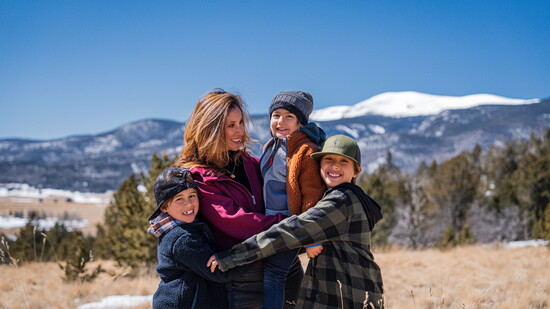
As the owner and publisher of Scottsdale City Lifestyle, I rarely insert my family into the stories we tell.
This one is different.
Vermejo is not simply a place my family has visited. It is part of our story.
Years ago, outnumbered by my husband and three sons, we traded our beloved beach vacation for a secluded stretch of northern New Mexico. For four days, we did all things boy: searching the snow for naturally shed elk antlers, practicing archery, and riding horses. Sitting inside a tent pitched on a frozen reservoir, we became the first family in years to catch Rio Grande cutthroat trout through the ice. Once nearing extinction, the species has made a remarkable comeback through a conservation partnership between Vermejo and the state of New Mexico.
I went into the trip thinking I was giving my sons an adventure.
I came home understanding that Vermejo had given all of us something much bigger.
That first trip was not our last. We have since returned multiple times and experienced Vermejo across different seasons. Each visit has brought new adventures, but the welcome has never changed. We have been embraced and treated like family.
Vermejo offers a level of privacy and exclusivity that is increasingly rare, yet it never feels isolating. You may be surrounded by hundreds of thousands of wild acres, but you never feel alone. Somehow, it feels both far removed from the world and remarkably close to home.
I have always believed not all classrooms have four walls. At Vermejo, the classroom might be a frozen lake, an alpine stream, a grassland filled with bison or a night sky dark enough to make a child stop talking and simply look up.
At the time, I wrote about the thrill of the experience. Today, I see the deeper story. Every one of those moments was possible because someone believed land damaged over generations could be given another chance.
That someone was Ted Turner.
This year marks 30 years since Mr. Turner acquired Vermejo in 1996 and committed to restoring its vast northern New Mexico landscape. It is also the first time I am writing about this place since his death in May at age 87.
That changes the story.
Recently, while speaking with Jade McBride, president of Ted Turner Reserves, our conversation stopped. He cried.
I cannot speak for Jade, but I can tell you what hit me: the strange ache of losing someone whose values remain so visibly alive.
Jade has said Ted “saw past a century of scars” and recognized what the land could become.
Vermejo is the answer.
When Turner purchased the property, the landscape carried the effects of mining, intensive logging, overgrazing, altered waterways and fragmented habitat. Thirty years later, more than 550,000 connected acres are protected and actively stewarded.
The conservation work is not tucked away behind the guest experience. It is the reason the experience exists.
Today, more than 1,200 genetically important bison move across native grasslands. More than 60 miles of mountain streams and 18 lakes have been restored as part of the effort to recover Rio Grande cutthroat trout. Riparian areas have been protected so willows, alders and cottonwoods could return, cooling the water, reducing erosion and creating conditions that brought beavers back to parts of the watershed.
More than 1,000 vascular plant species have been documented on the property, including two new to science. Tens of thousands of forest acres have been treated through thinning, regeneration management and prescribed fire.
Vermejo is also working toward official Dark Sky certification, a rigorous designation recognizing places that protect natural darkness through responsible lighting, night-sky monitoring and long-term stewardship. Here, even darkness is treated as a natural resource worth protecting.
There is no single best time to experience Vermejo because the land tells a different story in every season.
Every season gives you a different Vermejo.
Spring means warmer days, wildlife safaris and shed hunting, which turns the landscape into one giant scavenger hunt.
Summer opens the high country for fly-fishing, hiking, horseback riding, archery and guided shooting. If you visit over the Fourth of July, expect a wonderfully old-fashioned celebration with watermelon-eating contests, Wiffle ball and water balloons.
Fall brings cooler air and some of the best weather for fishing, hiking, riding and wildlife viewing.
Winter is how we first fell in love with Vermejo. Depending on conditions, you can snowshoe, ice fish on a frozen reservoir and experience a kind of quiet that is increasingly hard to find.
Where you stay and what you eat are part of the experience, too. Accommodations range from historic cottages and secluded, solar-powered mountain cabins to Casa Grande, the grand 25,000-square-foot stone mansion that has welcomed presidents, actors, actresses and other notable guests over the years.
The food is fresh and farm-to-table, with seasonal menus featuring garden produce, local game, Hatch green chile and fresh trout. You can enjoy a chef-attended cookout beside a rushing stream, dine at the water’s edge or end the day with a drink at the cowboy bar.
For our annual Style Issue, I kept returning to the same thought. What is in style at Vermejo?
It is not what anyone wears.
It is being outside. It is choosing experience over excess. It is watching children become curious about something larger than themselves. It is that the greatest luxury may be access to silence, dark skies, roaming wildlife and enough uninterrupted time to notice all of it.
Years ago, I ended my first Vermejo story with a hope I still carry: that our children will grow up to be good to this world.
But children also need places that show them what that looks like.
Vermejo is not a place to escape the world.
It is a place to remember our responsibility to it.
vermejo.tedturnerreserves.com