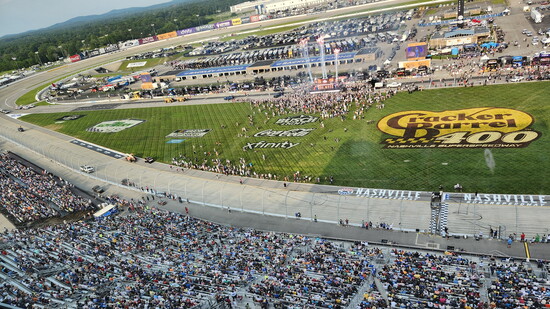
“We had to bring in two loads of dirt to have a groundbreaking,” recalls Don Stansberry, speaking about the ceremony that initiated construction of the Nashville Superspeedway, which is celebrating its 25th year of operation this year.
“After all, it was in the heart of a several hundred-acre cedar thicket, anchored by a Wilson County limestone floor, and home to scores of Timber Rattlesnakes,” said Stansberry, an attorney and general overseer of properties owned by the family responsible for building the 1.33-mile concrete track near Gladeville about 15 miles south of Lebanon.
Held on August 26, 1999, the Nashville Superspeedway groundbreaking was a green flag event for an opening NASCAR Busch Series (now Xfinity) race held some 20 months later on April 14, 2001. The legendary Greg Biffle, killed in a 2022 airplane crash, took the checkered flag at that first race, the Pepsi 300.
Building the track, an almost two-year-long $100 million construction project spread across portions of Wilson and Rutherford counties, required over 130,000 tons of concrete; has generated more than $24 million in local property taxes; and for a bonus, because ticket sales are registered in Wilson County, all local sales tax receipts from track events go to Wilson County. The facility has a permanent seating capacity of about 25,000, but on race days that number jumps to more than 40,000 with added temporary seating.
The late John W. Rollins, founder of Dover MotorSports, a Delaware company that owned the Superspeedway until the facility was sold by Dover in 2021 to Speedway Motorsports, is credited for picking the site and orchestrating construction of the venue that now hosts NASCAR Cup and Xfinity races and other events including Indy racing.
Although the name says Nashville Superspeedway, network broadcasters covering races for national audiences frequently announce that the track is located near Nashville in Gladeville, “a big deal” for Wilson County and for the rural crossroads community.
Jeff Rollins, son of the Superspeedway’s founder, said from the experience of Dover owning Fairgrounds Speedway at the time in Nashville, his father recognized that the region’s NASCAR fan base warranted a much larger facility. The strategy, he said his father applied, was to “build tracks in markets where there were large unserved audiences with strong broadcast ratings.”
Following through on his strategy, Jeff Rollins said his dad in the late 1990’s led Dover Motorsports to buy the Grand Prix of Long Beach, St Louis Speedway, and Memphis Motorsports Park, and build the Grand Prix of Denver, Grand Prix of St. Petersburg, and Nashville Superspeedway.
To build his track here, John Rollins searched along I-840 and piece by piece collected enough acreage from individual landowners to build a racing edifice designed as a D-shaped oval track that remains today NASCAR’s largest all-concrete venue.
Often described as a visionary, the late Rollins founded, co-founded, acquired or was on the board of nine publicly held companies and several private companies.
Stansberry said of his longtime friend that “John Rollins had the uncanny ability to look at what most would see as a worthless pile of waste and determine it to be a diamond in the rough just needing a little attention.”
Speaking in May at Cumberland University’s graduation, Rollins’s widow, Michele Metrinko Rollins, told the story of her husband growing up and working on a family farm in rural Georgia, walking nine miles to school, and later educating himself through correspondence courses.
The former Miss USA, who holds three degrees from Georgetown University including a Juris Doctorate, counseled the more than 1,000 graduates that to be successful in life, as her late husband, “you must work hard and practice three principles he adopted - determination, courage and integrity.”
She recalled that her husband, a former Delaware Lieutenant Governor, began his distinguished career of entrepreneurship borrowing $10,000 to acquire a Ford dealership in Lewes, DE. And soon after, he purchased two other dealerships. Then he saw a need to advertise his inventory, so he acquired a couple of radio stations, and with grit and grind and hard work, John Rollins managed to turn a humble beginning into an only in America-like dream.
The Nashville Superspeedway is just one of the late Rollins success stories. He launched Dover Motorsports, from which the local Superspeedway got its beginning; began a car leasing company that evolved into Rollins Truck Leasing; and purchased Matlack Systems, the country’s largest bulk trucking company.
He held controlling interest in Rollins Environmental Systems and served on the boards with family members of Rollins Inc – Orkin, RPC Energy, Marine Products, and Rollins Communications. He also had a significant interest and involvement with WSFS Bank, recognized as the oldest and largest locally headquartered bank in the Greater Philadelphia and Delaware region. Two companies for which he is responsible, Dover Gaming and Dover Entertainment, evolved after his death.
While the family continues to own some 1,500 acres near the Superspeedway, it also has other interests. In the late 1960s Rollins purchased the historic 7,000-acre Rose Hall Plantation in Jamacia that today includes two internationally famous golf courses, The White Witch and Cinnamon Hill, a number of vacation amenities, and the plantation’s magnificent Great House mansion built around 1770.
Even with these and so many other interests for which he was a part, it’s generally agreed among friends and family that one of John Rollins’s proudest accomplishments was the Nashville Superspeedway.
He died at age 83 on April 4, 2000, one year and eight days before the Superspeedway staged its first race.
John Rollins had the uncanny ability to look at what most would see as a worthless pile of waste and determine it to be a diamond in the rough just needing a little attention.