Homebuilding requires imagining daily life inside a space that doesn’t yet exist, a challenge that leaves room for costly misunderstandings, overlooked details, and lingering uncertainty. That disconnect between what we can visualize and what ultimately gets built is the gap Walk Your Plans Tulsa solves.
Interior designer Brooke Spencer and real estate agent Sarah Worrall-Lowe, co-owners of Walk Your Plans Tulsa, have both experienced this gap firsthand. “Clients regularly asked if a solution for this existed. Many struggle to visualize a room’s scale and what fits, sometimes cutting without realizing the importance of the space because they can’t physically experience it,” Brooke says. Sarah encountered this challenge while building her current home. “We had decided to cut 2 feet from our living room downstairs, which cut 2 feet from our daughter’s room upstairs. It made sense on paper, but only when walking the floor plan at our facility did our daughter point out the oversight: her Barbie Dreamhouse now wouldn’t fit in her room like we first thought.” Combined professional and personal experiences uniquely positioned Brooke and Sarah to see the value of technology that allows clients to walk through their blueprints.
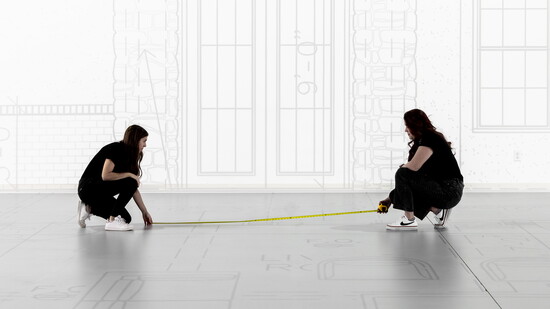
Walk Your Plans Tulsa transforms blueprints into spaces you can walk through. Inside Brooke and Sarah’s 5,000-square-foot facility, projectors beam blueprints to scale across 3,000 square feet of floor. Clients walk the distances from their future living room to the kitchen, to the garage, experiencing the flow of daily life. They can even place furniture to let clients see sofas, tables, and chairs in the rooms.
Beyond the floor experience, an elevation wall displays exterior views alongside interior details like cabinetry and appliances, creating a fully three-dimensional experience. “If walking through a home is critical when buying one that’s already built, why wouldn’t you do the same for a home you’re building?” Sarah says.
Walk Your Plans reports finding on average seven to twenty changes per hour during sessions. Recently, a Tulsa builder discovered six modifications in just one hour. At a conservative estimate of $1,000 per change, that's $6,000 saved, though some adjustments, like relocating doors and plumbing, can prevent upwards of $20,000 in expenses. Changes made before construction begins translate into real savings and fewer regrets down the road. “It’s far more economical to fix things on paper,” says Sarah.
Seeing a floor plan before the foundation is poured helps clients make decisions with confidence. “We had a client who was concerned about their truck and trailer hitch fitting in their garage, so we had the client actually drive their truck into the facility and park it in their garage,” says Brooke. That moment of certainty brought peace of mind that no measurement on paper could.
Tulsa’s building and development community has enthusiastically adopted Brooke and Sarah’s service, adding value for builders, architects, realtors, banks, and beyond. Walk Your Plans Tulsa has partnered with many local businesses already, including Mathis Homes, who has added Brooke and Sarah’s service to their home building process with every client. Vista Pools uses the technology to visualize pool dimensions at scale, and Renaissance Hardwood displays flooring options such as plank size.
For Brooke and Sarah, Tulsa feels like the perfect match. The city's growing population and corresponding construction boom create natural demand, while the community's welcoming spirit aligns with their mission to reduce the fear and overwhelm that often accompanies building.
At just one percent of a project's total cost, Walk Your Plans offers extraordinary value. Their long-term vision? Making to-scale blueprint inspection as standard as budgeting in the pre-construction process. "We're here to make sure every builder, every family, gets their dream right the first time."
We're here to make sure every family gets their dream right the first time.