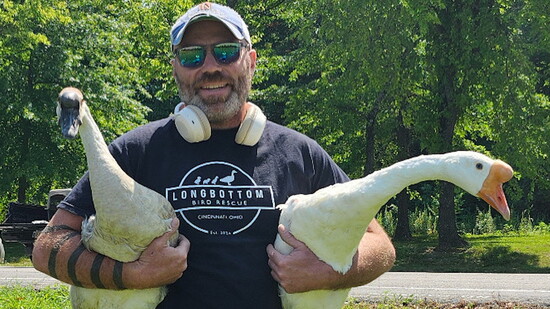
Although waterfowl rescue might not be top-of-mind for many, one man is working to address what he says is an unfortunate need.
“Domestic ducks have been crossbred over generations to create a larger version of their natural bodies,” Jimmy Longbottom, founder of Longbottom Bird Rescue, says. “Because of their size, they can’t fly. So, if an owner drops one of these birds in the wild, thinking, ‘It’s a duck, it will be fine,’ that bird is left to starve, freeze or be taken by predators,” he cautions.
“Unfortunately,” he adds, “if most people saw a pond of ducks starving or freezing, they wouldn’t even know it. To most people, a duck is a duck. We’re trying to raise awareness and compassion for these animals in our community.”
Longbottom Bird Rescue is a nonprofit 501(c)(3) domestic waterfowl rescue; its mission is to rescue and rehabilitate domestic waterfowl in crisis. It also strives to raise awareness and inspire a community where domestic waterfowl can be valued and treated with kindness. Longbottom currently cares for 215 geese and ducks.
For Jimmy, waterfowl rescue is personal.
“I had pet ducks myself, and began using social media to promote proper waterfowl care,” he says. “Someone reached out to me about a pet duck they were trying to surrender to a sanctuary, but couldn’t find one that would take it.”
At the time, he thought Animal Control, Ohio Department of Natural Resources or some other agency would have resources to help with the scenario. He quickly learned those agencies do not, in fact, have resources earmarked for waterfowl abandonment.
“So, I took the duck in myself,” Longbottom says. “That opened the floodgates—and here we are, over 200 birds later.”
Longbottom stresses that all of his organization’s funding comes from individual donations.
“We don't receive any state or federal grants,” he says. Instead, he counts on “a lot of big-hearted people” who follow along with the work that he does. “I also work a full-time job,” Longbottom says, “and that paycheck goes straight to the feed store.”
He explains that the organization’s biggest goal this year is to find a long-term home for its operations, currently leasing land from three different private farms to house the birds, which he has to visit every day. This year, he says, the organization continues to fundraise and search for a permanent space, where all of the birds can be together in one place.
“Once we have that,” he says, “we can finally begin offering tours and welcoming people to come out and meet some of our little miracles.”
Longbottom shares that an easy way to support the cause is simply following his organization on social media.
“That's where you can learn about free education events that we have coming up—and volunteer opportunities,” he points out.
Volunteer work and monetary contributions are also welcome.
Additionally, he shares a message for anyone considering acquiring a duck as a pet of their own: “They’re loud and messy. Not a great pet. Don't get one!” he says with a laugh.
Learn about how to invest in the Longbottom Bird Rescue flock with financial and volunteer support and see a full listing of upcoming Longbottom Bird Rescue educational events online. Instagram.com/longbottombirdrescue/
“I took the duck in myself. That opened the floodgates—and here we are, over 200 birds later.”
“I measure our success by how many people we engage with and carry our message to. Last year, we spoke with over 1,200 people at breweries, coffee shops and community centers in four different states.”