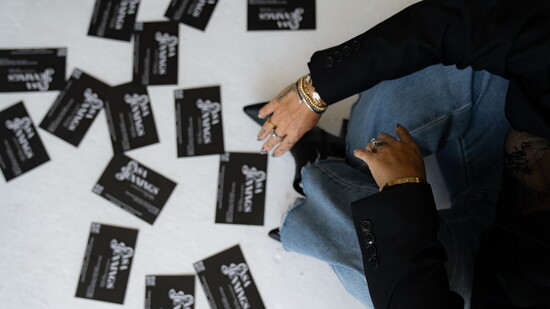
A New Home for Casa Jennings
Janet Jennings is the Latina designer and entrepreneur behind Casa Jennings, a San Antonio-based lifestyle brand known for its original Spanglish typography T-shirts. By pairing Spanish and English in designs created for strong women, Jennings celebrates cultural identity, confidence and the communities shaped by both languages.
Customer favorites such as Me Vale, I’m Nice… Pero No Te Pases and Bonita y Poderosa are funny, assertive and familiar. They allow women to wear expressions they may have grown up hearing or use in their own lives. Jennings designs and hand-presses each shirt, building the brand around the belief that style can reflect who someone is and where she comes from.
Jennings also knows what it means to start over. After losing the social media presence and customer history she had spent years building, she rebranded the business and moved its primary operations from McAllen to San Antonio. The experience strengthened her commitment to helping other women through her products, business partnerships and personal story.
The Beginnings of Casa Jennings
Casa Jennings began in McAllen in 2018 under its original name, Rep Shop. Its mission was to help women feel confident, beautiful and unapologetically themselves. The small boutique eventually developed into a lifestyle brand rooted in faith, family, culture and community.
The name Rep Shop reflected Jennings’ idea that customers should be able to shop for what they wanted to represent. One person might identify with a design about coffee or slow mornings. Another might choose a phrase connected to her faith, humor, personality or background.
“I could come up with 100 designs, but you have the opportunity to shop for the designs that you loved and felt as though you could identify with,” Jennings says.
The business started inside Jennings’ home during an especially full season of her life. A wife and mother of four boys, she was raising one-and-a-half-year-old twins while creating designs and building Rep Shop from her bedroom.
“I built it from the floor up,” she says. “I had two babies on one end, trying to bottle-feed them while I was trying to build a business. I raised both a business and babies at the same time.”
Because Spanish is Jennings’ native language, combining it with English felt natural. She turned familiar expressions, attitudes and cultural references into apparel that sounded like the women wearing it. As Rep Shop grew into a McAllen storefront, she expanded its selection to include boutique clothing, jewelry, accessories, gifts and home décor. Her original designs, however, remained at its center.
The Designs
The Spanglish shirts continue to distinguish Casa Jennings from a conventional clothing boutique. Jennings develops each phrase, creates the typography and hand-presses every shirt after it is ordered. The designs reflect the way Spanish and English come together in everyday conversations, particularly within Latino families and communities.
During her years in the storefront, Jennings especially enjoyed helping customers who did not feel confident selecting or styling clothing. She noticed that those insecurities affected women across sizes, including some who appeared confident when they entered the store.
“It could be a really skinny girl or a thicker girl,” Jennings says. “You’d be surprised. Both alike may not have the confidence that women sometimes portray.”
Whether she was helping a customer assemble an outfit or select a shirt that captured her personality, Jennings wanted women to leave feeling confident enough to be unapologetically themselves. Her number-one seller, Me Vale, roughly translates to “I don’t care” and offers one example of that attitude. Jennings says its meaning depends on the woman wearing it. It might express a decision to stop worrying about other people’s opinions, or it might simply describe someone easygoing enough not to dwell on minor problems.
“It’s really perspective,” Jennings says. “Someone may say, ‘I don’t care' is pretty irresponsible.’ But someone else can say, ‘No, I’m just very nonchalant. I’m an easygoing girl.’”
Jennings also creates custom shirts for businesses and staff teams, another significant part of Casa Jennings’ sales. Seasonal collections allow her to experiment with familiar language and imagery. A committed Halloween fan, Jennings’ favorite fall designs are inspired by monsters, jack-o’-lanterns and Mom-ster, a fun and festive take on protective mothers.
The designs gave women a way to represent themselves through what they wore. When Rep Shop developed into a physical boutique, Jennings carried that same idea beyond her own collection by giving other women a place to represent their work.
Women Helping Women
Jennings wanted the storefront to do more than sell clothing and gifts. She also wanted to offer a retail presence to women-owned businesses that could not yet afford storefronts of their own.
At one point, the boutique carried products from as many as 11 local women-owned businesses, many operated by single mothers. Each vendor gained a place to showcase her work, introduce her brand to new customers and experience selling within a physical store.
“That was the framework behind the boutique vision that I had,” Jennings says.
Jennings had briefly been a single mother herself, which she describes as one of the most testing periods of her life. The experience gave her a particular concern for women trying to support their families while building something of their own.
Her assistance extended beyond displaying their products. Through her involvement with women’s organizations, boards and community panels, Jennings had developed relationships with local professionals and entrepreneurs. She introduced vendors to people in her network and helped them form connections that could move their businesses forward.
Some eventually required more room than Casa Jennings could provide. Jennings viewed their growth as the purpose of the arrangement. The boutique could be a starting point where women tested ideas, developed customer bases and prepared for what came next.
“When one woman succeeds, we all succeed,” she says.
Jennings applied that same principle to customers. Supporting women did not always involve shelf space or a professional introduction. Sometimes, it meant noticing what one customer needed and finding a way to include her.
Community
Jennings remembers introducing a charm bar where customers could select a chain, have it cut to size and add charms to create a bracelet, necklace or anklet. Soon afterward, a woman contacted her and explained that she had never owned an anklet. She asked whether Casa Jennings could make one to fit her.
When the woman arrived, Jennings learned that a medical condition had caused significant swelling and changes to her legs and ankles. A conventional eight- or nine-inch anklet would not fit. The piece she needed had to be approximately 21 inches long.
The customer offered to pay double for the additional material. Jennings measured her and created the anklet but charged the regular price.
“You deserve to feel beautiful just like anybody else,” she told her.
The customer became emotional when she received her first anklet and told Jennings that she did not understand what she had done for her that day. For Jennings, the encounter represented what made the uncertainty of running a boutique worthwhile. Independent retailers must persuade customers to choose their products while competing against large companies, fast-fashion prices and rapid shipping. Jennings works to keep Casa Jennings’ prices accessible and typically prepares handmade shirt orders within approximately three business days.
The anklet, however, carried a value unrelated to the amount of chain used.
“What I wanted was for her to feel loved, confident and cute,” Jennings says. “I want to build relationships with my customers, not just sell them something.”
Those relationships became especially important when Jennings lost the digital history of Rep Shop and faced the possibility of walking away.
A New Chapter in San Antonio
In 2024, unwarranted repeated reports against Rep Shop resulted in its social media accounts being shut down. Jennings lost years of followers, reviews, photographs, videos and customer conversations.
The loss was professional and personal. Social media had become an informal record of the years when Jennings was raising her twins and building Rep Shop from her bedroom. The missing photographs and videos included memories of her babies beside her while she worked.
The accounts had also become a primary way to promote products and communicate with customers. Reestablishing the brand meant beginning again in a retail environment heavily influenced by social media advertising, online engagement and existing audiences. For a time, Jennings wondered whether the loss was a sign that she should close the business.
“But a part of me felt like I didn’t want to let go,” she says. “I wanted to be resilient.”
Jennings chose to rebuild under a new name: Casa Jennings. “Casa” connected the brand to its beginnings inside her home and described the space it had provided for other entrepreneurs. “Jennings” incorporated the family name that had accompanied the business through every stage.
“More than a boutique, it’s a house,” she says. “It’s a home for so many other brands. I didn’t want that to be lost.”
The new name marked a change without discarding the work that came before it. Jennings retained the original designs, women-owned partnerships and approach to customer service that had defined Rep Shop.
Her family later received an opportunity to relocate to San Antonio, bringing Casa Jennings into another period of transition. Jennings moved the brand’s primary operations with her and now runs it mostly online from a home studio. Approximately 90 percent of the collection is available through its website, and local customers can arrange San Antonio pickup.
The online store includes Jennings’ original typography shirts alongside boutique clothing, jewelry, accessories, gifts, home décor and personalized items. Jennings is now introducing Casa Jennings locally, rebuilding its customer base and considering what a future physical presence in San Antonio might look like.
Jennings wants her experience to encourage women facing setbacks of their own.
“You can choose to rebuild, and that’s okay,” she says. “We have setbacks, but you just have to remain resilient.”
San Antonio gives Casa Jennings a new home and an opportunity to reach another community. Jennings intends to use that opportunity to continue what she began in McAllen: designing clothing that ties together language and culture, helping women bring their businesses before customers and showing that starting over does not have to mean giving up what came before.
"When one woman succeeds, we all succeed."
Say It in Spanglish
Casa Jennings' bestselling shirts turn familiar expressions into designs women can wear according to their own personalities.
Me Vale, the brand's number-one seller, roughly translates to "I don't care." Janet Jennings says it can signal confidence, freedom from other people's opinions or simply an easygoing attitude.
I'm Nice... Pero No Te Pases pairs friendliness with a firm boundary: "I'm nice, but don't cross the line." The message is approachable, but also makes clear that kindness should not be mistaken for weakness.
Alérgica a Amargadas playfully declares an allergy to those who carry bitter or negative energy. Another customer favorite, Bonita y Ponderosa, celebrates being both beautiful and powerful.
Jennings creates the wording and typography herself, then hand-presses each shirt after it is ordered. By moving naturally between Spanish and English, the designs capture humor, confidence and cultural references that many customers recognize from their own families, friendships and everyday conversations.