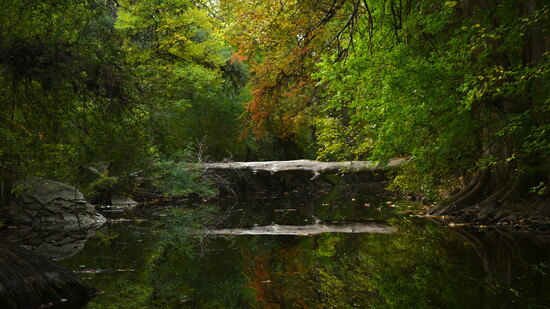
The waters of Cibolo Creek are tricky. The stream’s well-defined banks give the impression that the Cibolo moves along a clear course, twisting but steady. It’s obvious when one looks at the stream, isn’t it? After its gentle arc around Boerne, it heads southeast to San Antonio and the aquifer, then outward, too far to trace. There seems to be little reason to consider a river’s course at all.
The stream’s unhurried, languid flow could lull the rushed river-watcher into believing its continuity is simple, but I like to think the story is much more complex. Watch a beat longer, and the stream’s current reveals itself as dynamic and woven, shaped both by human decision and water’s insistence. On second glance, the seemingly tidy stream channel twists and braids, occasionally leaving water in a forgotten oxbow. Given time, those isolated pools will rejoin the Cibolo.
To the patient river-watcher, the meanders of Cibolo Creek may resemble the lives of this region’s folks. The flow visible to the naked eye is not the entire creek, but only its most prosaic expression. The waters move through the hungry roots of the cypresses and the yawning cavities of the Edwards alike. When viewed from its banks, the river-watcher may realize what looks simple here only works because of the ties that hold it together.
Since deep time, people of many tribes have drunk from the Cibolo, sustaining the ties between them and this, their chosen patch of earth. Separated only by the stream's meanders through time, Comanche people drank these waters much like their Tonkawa forebears had, and later Germans would. The creek slaked the thirst of countless families, creating new lives in an arid, mercurial place. Five generations on, Boerne's relationship with the Cibolo deepened when folks living along the stream came upon an unexpected bend.
Near the end of the last century, the Cibolo had become a ghost of its former self. Too much use and too little love left the creek worn down. The lives those waters touched, plant, animal, and human, felt that shift. The citizens of Boerne reached out to the Cibolo in a new way, this time asking what they could do for the stream that had nurtured them.
The debris that had stifled the stream's flow was removed and replaced with attentive ears and willing hands. The purposeful river-watcher can now observe a stream that nurses red-eared sliders and mud-streaked kids in the same eddies. That same stream continues to give water to those who still thirst. Then, as now, those along the Cibolo heard the stream and responded.
In April of this year, Wrede Marsh on The Cibolo Center for Conservation's main campus stood bone-dry, the cracked mud tiles of its main pool surrendering edges upward to the sun. Within a few days, the rains fell and the marsh filled. A week before, nothing but a foot of dusty hot air cushioned those squares. Now, a dinner-plate-sized red-eared slider glided past in a space empty a week prior, nibbling a fresh underwater buffet. The turtle spooked a diamondback watersnake, and in an explosion of silt and water, both slipped away. In time, that turtle has the chance to make it all the way to the Cibolo and beyond, if it's so inclined. The snake, too.
As the turtle glides, the Cibolo goes. Beyond the city limits of Boerne and the confines of the Hill Country, the stream meets other rivers, flowing toward the Gulf and another cycle across the land. Marsh levels downstream continue to rise and fall with the seasons. Turtles glide on water, moving from here, and the Cibolo flows.
Since deep time, people of many tribes have drunk from the Cibolo, sustaining the ties between them and this, their chosen patch of earth.
Beyond the city limits of Boerne and the confines of the Hill Country, the stream meets other rivers, flowing toward the Gulf and another cycle across the land.