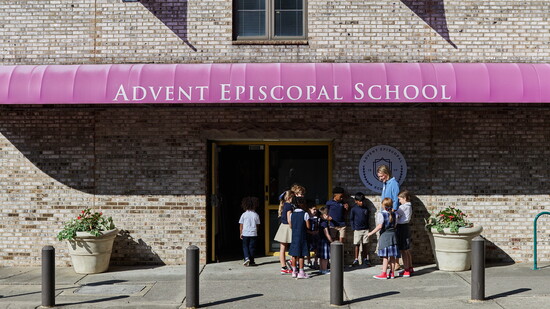
You attended Advent from pre-K through 8th grade. How has Advent changed, and how has it remained the same since your time as a student? What specific memories stand out?
What’s remained constant is a culture of high expectations held together with genuine belief in kids. That duality—we expect a lot of you, and we believe in you—was true when I was a student, and it’s true now. I had teachers at Advent who genuinely cared about me, who I’m still close to today.
What’s changed most is our increased intentionality about being a downtown Birmingham school—not just in the sense of convenience, but as a core part of our identity and curriculum. We have a program called Discover BHam that gets our kids out into the city in real, structured ways. McWane, Children’s Theater, Jones Valley Teaching Farm, the Museum of Art, the Civil Rights Institute—those have always been walkable from our front door. What we’ve worked to build is making them living parts of how we teach, not just field trip destinations.
My specific memory has to be the second-grade play. Every year, our second graders do a musical. When I was a student, we performed Goin’ Buggy, and I can still sing nearly every song! I keep a photograph (bubble paint and everything) from that production in my office today. This year, our second graders performed at Terrific New Theatre. That tradition is alive and only getting better.
And there’s something I still haven’t gotten used to—walking up a stairwell to a teacher meeting or into the pre-K classroom and being able to close my eyes and still feel like a student. That sense of memory keeps me grounded. The decisions I’m making about this place, the culture we’re building—I understand in a visceral way that they matter, because I lived it here first.
What role do you think Advent does and should play in Birmingham’s overall academic landscape?
Our role is to demonstrate what’s possible when you hold two things together that people sometimes treat as opposites: high expectations and high nurture. At Advent, those aren’t in tension—they reinforce each other—and I think that’s what makes us distinct.
Birmingham has extraordinary schools—public and independent—and I don’t think our job is to compete with them so much as to offer something genuinely different. We’re a JPK–8 school in the heart of downtown, rooted in an Episcopal tradition that takes the whole child seriously—intellectual, spiritual, social, emotional. What I’m most proud of is the community we’ve built—students from more than 40 zip codes across Birmingham, with genuinely diverse backgrounds, learning alongside one another every day. That’s not an accident—it’s something we actively cultivate, and I think it makes the education richer for everyone.
For families who want small classes, teachers who really know their kids, a diverse community, and an urban environment that’s part of the education itself, we’re the answer.
I’d love for Advent to be the school that proves downtown Birmingham is a place you choose for your family—not a place you feel like you need to leave.
What are the biggest and most critical challenges facing educators today?
Honestly? Attention. Not just students’ attention — everyone’s. We’re all living in an environment that constantly fragments our focus, and schools haven’t fully reckoned with what that means for how kids learn and how teachers teach. The cognitive science is pretty clear: deep learning requires sustained, focused engagement. That’s hard to build when the culture outside school is optimized for the opposite.
The other challenge I’d name is the gap between what we know about how kids learn and what actually happens in classrooms every day. Research on reading, on memory, on how kids retain information — a lot of it has been around for decades. The hard part isn’t knowing it. The hard part is making it real in every classroom, every day, for every kid. That’s where I spend a lot of my energy.
What is your stance on smartphones in school?
Fortunately, Advent has had a no-phone policy for a long time—we sometimes joke that where we once felt behind the curve, we found ourselves ahead of it!
But in all seriousness, smartphones simply aren’t necessary in a child’s school day. Our kids have a cart we call “Dolly Carton”—she works from 8 to 3—and students drop their phones off at the beginning of the day and pick them up on the way out. They’re not sitting in lockers, they’re not sneaking into bathrooms. There’s a shared understanding that we want kids fully present.
What’s actually more interesting to me is the harder question: what’s the role of the smartphone for the adults in the building? Phones have given teachers and staff real benefits—connection, security, access to information, and materials. But adults can find themselves just as distracted as kids. The easy answer is no phones for students. What becomes harder—and more honest—is reckoning with what we’re asking of adults, too.
How are, how can, and how should educational leaders address some of the mental health challenges facing children, based on social media, screens, and other factors?
Mental health challenges facing kids aren’t new—but we are seeing them more frequently, and in younger and younger students. I don’t think we can point to any single cause. Social media, screens, the pace of modern life, the loss of unstructured time—it’s a perfect storm, and it would be too simple to blame any one thing.
What I do believe is that when we talk about educating the whole child, this has to be part of it—not as an afterthought, but as a genuine institutional commitment. At Advent, we’ve invested in a strong school counselor, we’re fortunate to have a full-time school nurse, and our Dean of Students works closely with both to make sure we’re seeing kids clearly and responding well.
But what I’d want any educational leader to understand is this: no single meeting, no single plan, no single policy will fix it. We have to approach mental health the same way we’d approach any significant health challenge—with sustained support, humility about what we can and can’t do, and a real commitment to walking alongside families.
How can and should schools address the number of students being diagnosed and living with ADHD?
We have to address ADHD with more nuance than the diagnosis alone provides. ADHD is real, and it manifests very differently in different kids. A diagnosis is a starting point, not a ceiling—and it’s not an invitation to lower expectations.
What it is an invitation to do is understand the brain science and identify the supports that allow that student to be successful. I’ve seen kids flagged as behavior challenges where what you're really seeing is undiagnosed ADHD. I've seen kids whose ADHD presents as hyperfocus rather than inattention—a child who can spend four hours on Legos but struggles to sit through a science lesson, yet thrives in math because they love it. A single diagnosis doesn't define a student, and it rarely tells the whole story.
What I find most compelling is that many of the strategies that help students with ADHD—movement, chunked tasks, clear structure, retrieval practice—are just good teaching. The diagnosis often surfaces practices that benefit every student in the room.
How can parents better prepare children for college and the process of choosing one?
This one actually comes up more than you'd think—sometimes even when we're talking with a family considering Advent for their three-year-old!
I think it's worth stepping back and reorienting the question. Rather than "how do I get my child into a good college," the more useful question might be "what does my child need to become a capable, curious, resilient adult?" Those questions often lead to the same place—but organizing around the second one tends to produce better decisions along the way.
Practically, I'd encourage families to think broadly about fit and belonging. There is extraordinary education happening at schools you've heard of and schools you haven't—at state flagships, at small liberal arts colleges, at universities that might surprise you. The right college is the one where your child will be challenged, supported, and stretched. That's a wider and more hopeful universe than the college rankings conversation sometimes suggests.
A particular college may be a wonderful outcome of the goals you set for your child. I'd just encourage families not to mistake it for the goal itself.
How is AI changing education, and how should schools respond? What is Advent's current stance?
AI is the most significant shift in how humans interact with information and knowledge production since the Internet. The temptation for schools is to go all in or shut it out entirely—and I think both responses miss the more interesting question: what does it mean to know something now? What does human judgment, synthesis, and creativity look like in a world where a machine can produce a passable essay in seconds?
The skills that will matter most are those that make AI an amplifier rather than a crutch—problem-solving, critical thinking, and discernment. And here's the thing: you can't use AI to amplify thinking you haven't done yet. You have to understand how the parts come together before a tool like this can genuinely extend you.
At Advent, we're very much in that conversation with our faculty right now. We're thinking about how AI can enhance what we're doing as a school—and we're being deliberate about the student side. We're having some early conversations with our middle schoolers, but I'm comfortable with the fact that we're not rushing it. So much of developing those critical thinking and discernment skills comes from doing the original work yourself first. Once students have that foundation, they'll be genuinely equipped to use these tools well.
In an age of screens and AI, what human skills matter most?
I touched on critical thinking and problem-solving in the last answer, but the human skill I keep coming back to—especially in the context of screens and AI—is connection. Real, in-person, human connection.
There's something genuinely powerful about technology that lets you FaceTime a friend who's moved away or stay close with grandparents across the country. I don't want to dismiss that. But I think screens and AI can create a kind of protective lens—they make us feel connected while also keeping us at a safe distance. And over time, I worry that distance becomes a barrier to the deeper connection that humans actually need.
The ability to sit across from another person and have a real conversation—to be present, to be uncomfortable, to work through something together—that's a learned skill. And it's one we have to be much more intentional about cultivating, because so much of the world right now is making it easier to avoid.
How can parents and educators work better hand in hand?
It starts with assuming good faith on both sides. Parents who push back on a grade or a decision aren't always being difficult—sometimes they have information the teacher doesn't. And a teacher raising a concern isn't attacking your child—they're doing their job. The relationship works best when both parties treat it as a partnership toward the same goal.
I use the analogy of sitting at a table. We're not across from each other, going back and forth. We're sitting next to each other, with the child's needs in front of us both.
What I ask of parents is the same thing I ask of teachers: recognize what each person brings. You are the expert on your child. The teacher is the expert in the classroom. The magic happens when those two kinds of expertise come together in service of the student.
What habits or routines do you see in thriving students and families?
I want to be sensitive here because what works for one family doesn't work for every family. But there are some things I've observed that consistently seem to help.
The biggest one is talk. Are you asking your child about their day—what they learned, what happened with their friends? And timing matters more than people realize. When your child gets in the carpool line at 3 o'clock, they are exhausted. They've had a full day, their cognitive load is high, and the last thing that happened is often the first thing out of their mouth—which means you might hear about the scuffle on the playground at 2:30 before you hear anything else. Families that can resist reacting to that one thing tend to do better. Save the real conversation for the evening—dinner, bedtime, whatever works for your family—when everyone has had a chance to decompress.
As kids get older, I’d also encourage parents to resist the urge to fix everything. When your middle schooler comes home upset, try “that sounds really hard—what do you think you’ll do about it?” rather than reaching for the phone to call the teacher. Building that sense of agency in kids is one of the most valuable things a family can do.
On activities—every family has a different threshold for busy, and I’d encourage parents not to compare. Some families thrive running in a million directions. Others need to pick two things and protect the white space. Trust what you know about your own family.
What books do you recommend every parent read? Students?
For parents, a few books I keep coming back to. The Anxious Generation by Jonathan Haidt has gotten a lot of press—and I know that can sometimes make you want to skip something—but it really is worth the read. It’s just good information that equips you in a meaningful way.
Two you might not have heard of: Play by Stuart Brown and Grit by Angela Duckworth. Brown makes a compelling case for what unstructured play does for kids’ development—cognitively, socially, emotionally—and it’s honestly a little humbling given how much our culture has scheduled it out of childhood. Duckworth’s research on perseverance over raw talent is equally eye-opening, and it pairs well with the third book I’d recommend: Mindset by Carol Dweck. She’s a cognitive psychologist, and the book is about growth versus fixed mindset—but what makes it so useful for parents is that it’s really about the language we use with our kids every day. The way we praise them shapes how they respond to challenge and failure in ways most of us don’t realize. I keep coming back to it.
For students—read what interests them. Books are a wonderful escape, allowing us to see ourselves reflected or to recognize experiences beyond our own. Keep reading with your kids even after they’ve learned to read on their own. We tend to read aloud to young children, and then, somewhere along the wa,y, that stops. But reading alongside your middle schooler—or even just reading in the same room—has real benefits. Don’t give that up too soon.