The last time I saw Brendan Hunt, we were doing what you do in Amsterdam when the night refuses to end. Riding bikes. No destination. Just a loose caravan of old friends pedaling through quiet streets after too much dancing and not enough sleep, celebrating Boom Chicago’s 30th anniversary with past and present cast members who all somehow still feel like family. It was nearly three decades after that theater first shaped both our lives, though on different timelines.
When Brendan arrived in 1999, I was just finishing a four-year stint of balancing grad school and writing for Bloomberg while orbiting the comedy club. He was an improv actor soaking up the city, the work and the strange alchemy that happens when you are far from home but surrounded by people chasing the same thing. What bonded us was not chronology. It was sensibility. Curiosity. A shared understanding that comedy, at its best, is less about being clever than being present.
That feeling has not changed. It’s the throughline of his work.
Where the investment began
This spring, Hunt returns to Chicago with The Movement You Need, a deeply personal one-man show running April 19 through May 10 at Steppenwolf Theatre Company. The show is funny. Vulnerable. It’s fueled by memories of a Chicago childhood, a lifelong devotion to The Beatles and a restrained encounter with Paul McCartney that becomes the emotional hinge of the evening. More than anything, it’s about inheritance, emotional survival and the stories we carry forward, whether we realize it or not.
“I moved a lot,” Hunt tells me. “I went to a lot of different schools.” He talks about early years on the North Side, a formative teacher at Nettelhorst Elementary who made him “feel smart,” and later, Kenwood Academy in Hyde Park. “They invested in me in a way I’d never really experienced before,” he says. “So the Chicago Public School System did me right.”
Brendan has always been a collector of meaning. For Hunt, Chicago is not just geography. It’s rhythm. The lake always east. The grid grounding you. By ten years old, he could navigate the CTA alone, which is equal parts alarming and empowering.
“I’m glad to be from the city,” he says. “To have been part of a place with its own heartbeat—and to feel that place become part of me. Like, familiarly. The DNA of the rhythm of the city.”
First returns
That rhythm shows up in his humor, too. An eighth-grade field trip to Second City cracked something open. “It just blew me away,” he says. “What a world we live in, that these things happen. You start to think about being one of the people doing them.”
When he moved to Amsterdam at the end of the 1990s to work as an improv performer, it wasn’t just for adventure. The timing was its own force. A young marriage had ended, and he was living alone in Chicago when the recruiters invited him to audition. He went with no intention of taking the job. Ten minutes into hearing about Amsterdam, he wanted it more than anything he’d wanted before.
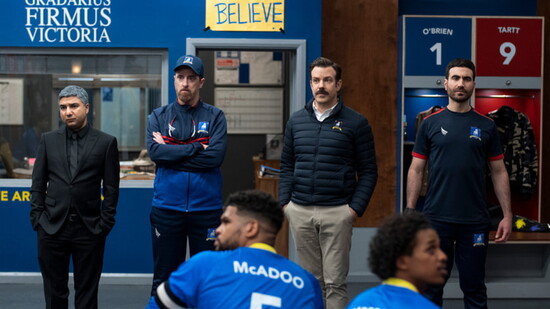
At Boom Chicago, commitment was not optional. You performed constantly, often for drunk audiences navigating English as a second language. That ethic never left him. It’s there in his writing on Ted Lasso, in the quiet humanity of Coach Beard, and now, most nakedly, in this show.
Steppenwolf loomed large even then, holy ground at a distance. Hunt never performed there, though he once understudied a young Michael Shannon in the late 1990s, a fact he recounts with both awe and humility. Now, decades later, he steps onto that stage carrying a story that could only exist because of where he started.
“Performing in my hometown is a joy in any circumstance,” he says, “but particularly with this show, which has so much Chicago in it.”
The show’s shape was refined in close collaboration with director Ashley Rodbro and lead producer Vivek J. Tiwary, both of whom Hunt credits with protecting its emotional honesty. At Steppenwolf, the piece found the right scale. Intimate, exacting and unafraid of quiet, it finally had room to breathe.
What gets passed down
At the heart of The Movement You Need is Hunt’s relationship with his mother. “It was fairly rocky over the years,” he says. “I didn’t realize it until I was well into my 20s, but she’d been an alcoholic almost all my life.”
What they shared, what saved them at times, was music. The Beatles were the concord. She did not always have the vocabulary for love, he tells me, but she had their songs, and she made sure her children did too.
“She grew up with parents who loved her, but who didn’t know how to express that love,” Hunt says. “But the Beatles expressed love, and she latched onto that.”
That inheritance matters. In his telling, it becomes both lifeline and lens. Hunt speaks about the Beatles not as untouchable geniuses but as a model of how to live and work. “No one says George Harrison is the best guitarist of all time. No one says Ringo is the best drummer,” he says. “But they are the best band, because all they cared about was making each song the best it could be. Serving the piece. And serving the piece is the most important thing an artist can do.”
That philosophy extends to the show’s title, lifted from “Hey Jude,” a song that has followed him since childhood. As a toddler, his attempts to pronounce his own name came out as “Nana,” and the nickname stuck. When he heard the song’s long na-na-na refrain, he assumed, quite logically, that it was about him.
Over time, the song evolved with him. What began as kind of possessive affection deepened into something else. “The movement you need is on your shoulder,” a line McCartney nearly discarded, became instruction. Self-sufficiency. Permission. The reminder that you can take a sad song, a sad situation, a sad feeling, and make it better.
Years later, he understood why it resonated more deeply. “The song is advice to a child of divorce,” Hunt says. “Well, I’m a child of divorce. It seems to be speaking to me on a number of levels.”
The value of restraint
That understanding reframes the show's emotional centerpiece, the night Hunt met McCartney. Thanks to Ted Lasso, he found himself watching Paul rehearse with Dave Grohl for a massive Wembley show. "What am I going to say to him?" Hunt remembers thinking, trying hard not to say anything foolish.
“You can’t say all the stuff you want to say,” he tells me. “So what I didn’t say becomes the thing.” The movement is internal. The restraint is the revelation. But that kind of inward work has a cost.
The show is draining for him in ways other performances never were. Eighty minutes onstage leaves him emptied out, more than years of improv or long theatrical runs ever did. It’s emotional labor, excavation and release.
“It’s draining and fulfilling and painful and healing and torture and delight,” he says, with a kind of weary amusement.
Hunt began writing the show in 2023, seven years after his mother died in 2016. By then, he had also become a father himself. That distance changed the story. Empathy arrived where anger once lived. Understanding replaced blame.
“Seeing it from that perspective made it all feel a bit gentler,” adds Hunt, who now lives in Los Angeles with his wife, Shannon Nelson and their two young sons. Fatherhood clarified the stakes.
The shared return
Chicago audiences will recognize themselves here, even if they do not love the Beatles. Hunt jokes that some people will walk in unaware of how central the music is and leave begrudgingly more open-minded. What he really hopes, though, is that people leave knowing they are not alone in what they carry. That sadness can coexist with joy. That humor and vulnerability are not opposites.
“I want people to know that when you’re going through hard times, you can take a sad song and make it better,” he says. “Because the movement you need is on your shoulder.”
As we rode those bikes through Amsterdam, weaving through streets that once held our younger selves, it struck me how little had changed at the core. The same curiosity. The same belief in shared experience. Now, that belief lives onstage.
The movement we need, it turns out, has been there all along. In telling this story, Hunt shows what happens when you invest in the truth of your own life and trust that others will meet you there.
“Performing in my hometown is a joy in any circumstance,” says Hunt, “but particularly with this show, which has so much Chicago in it.”
Chicago, According to Brendan
I asked Brendan Hunt to define Chicago in the small, specific ways that last. A Proust-adjacent exercise he answered like a true local: nostalgia with opinions.
Favorite Chicago…
Indulgence: Christmas Frangos from Aunt Ellen, always gone by New Year’s
Sound: A certain “kachunkaCHUNK” between North/Clybourn and Clark/Division (on the ’L’)
Smell: Inside Harold’s (Chicken Shack)
Fix-Everything Food: Chicken Vesuvio at Dublin’s
Hour-to-Disappear Spot: GMan Tavern
Treasured Memory: Working as a pinboy at (the now shuttered) Southport Lanes
Sports Memory: 1986 NFC Championship Game with my dad
And for good measure…
Most Chicago-Like Trait: Still mad the giant Thillens baseball is gone
Perfect Chicago Happiness: A low-stakes 16inch softball game with exactly the right friends