Forty million, two hundred thirty-eight thousand dollars. Cash.
On July 9th, 2026, a nearly two-acre estate at 5531 East Mockingbird Lane in Paradise Valley became the most expensive residential sale in Arizona history. By the next day, the number was making national news.
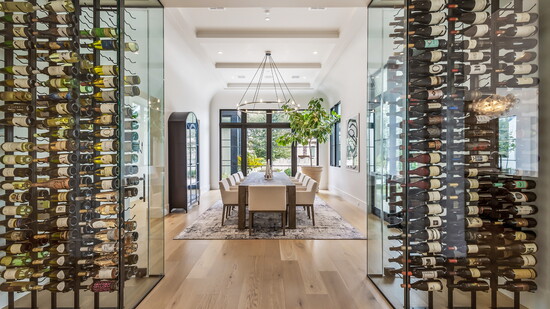
At 20,919 square feet, the residence has 8 bedrooms, 11 bathrooms, two 432-bottle wine walls, resort-caliber wellness spaces, a salon, a shooting range, a theater, a safe room, an underground go-kart track and enough space across the property to indulge a serious automobile collection.
Behind the record are two distinct perspectives. Katrina Barrett represented the seller and has now represented Arizona’s two highest residential sales. Mark Candelaria, founder and principal of Candelaria Design, is the architectural visionary behind the estate, shaping it from its original footprint through a dramatic expansion.
One knows what makes a buyer say yes. The other knows what makes a home impossible to replicate. Together, they answer the $40 million question.
The irony? The woman behind Arizona’s biggest residential deal has barely celebrated it.
“I do a bad job of celebrating wins and tend to keep looking forward to what's next in the pipeline. Sometimes I even cringe when the big ones sell or generate a lot of press because your competition doesn't always celebrate your success, and being good to your peer group is important in real estate,” Katrina says.
Asked whether she has stepped back to appreciate what she accomplished, her answer is simple.
“No.”
Then comes the reality behind the headline.
“Often when one listing achieves a great sale, another seller becomes more pushy about why they aren't accomplishing the same thing. It adds pressure, but these large sales are good for all of Arizona and continue pushing the boundaries of what's possible in our market.”
Katrina is characteristically direct about an industry in which one extraordinary result can create as much expectation as celebration.
“Personally, no one sale shifts the needle dramatically,” she says. “Finding ways to improve our systems and making sure clients are happy and well served are much more important. Markets change, marketing tools and tactics evolve, and I work hard to adapt so we can continue delivering exceptional results for our clients.”
Her first impression of the estate was far less complicated.
“This home checked more boxes than any home I have ever listed. The seller and build team took meticulous care in how it was crafted, and we were incredibly thankful for that attention to detail.”
The boxes, in this case, are not subtle. The home includes a fitness center, gym, cold plunge, sauna, salon, massage room and multiple wings and gathering spaces designed to entertain on an enormous scale.
Above ground, the architecture stays light, clean and composed. Below ground, all bets are off.
“The basement… it’s over the top,” says Mark Candelaria.
Yet the home did not begin as a 20,000-square-foot private resort.
Mark describes the original residence as an approximately 7,000-square-foot, five-bedroom home with a four-car garage and detached guest house. When the neighboring lot was acquired, the vision expanded: approximately 2,000 additional livable square feet on the main and upper levels, a gym, toy room, garage loft, an 18-car garage, more than 10,000 square feet below ground and another two-bedroom guest house.
“The simple Transitional Style carried right from the original home to the new additions making the home unified and seamless,” he says.
The architecture was intentionally neither aggressively modern nor overtly traditional.
“We used clean lines and minimal details with light and bright materials. Every opportunity to employ indoor-outdoor living was captured.”
Even the garage understands presentation. Rather than one cavernous room, its 6,000 square feet were divided into smaller collections.
“We broke up all the garage spaces into two to 4 car vignettes so in essence each space is its own showroom and collection.”
Not to mention the wine display. Two glass walls, each designed for 432 bottles, flank the opening to the dining room, creating what Mark calls “a wonderful prelude to the dining experience.”
And naturally, the kitchen has a backstage.
“Extra ovens, refrigeration, warming drawers and tons of storage in the ‘Dirty Kitchen’ keeps the clutter out of the ‘Pretty Kitchen’,” he says.
On the lower level, a theater, safe room, salon, spa, sauna, massage room, lounge, bar, playground and go-kart track unfold as one cohesive experience rather than a collection of amenities.
“There's flow to all of it.”
For Katrina, one dazzling room will never separate a $10 million home from a $40 million one. Everything has to arrive together.
“Square footage, lot size (this home truly had the equivalent of a football field) along with exceptional views, privacy, and world-class amenities are what separate a $40 million home from a $10 million home.”
Yet the features that say the most about what is in style now are not go-karts, gun ranges or garages. They are the spaces devoted to wellness.
“People are drinking less and exercising more, so those spaces are driving demand. At the same time, this estate was truly an entertainment retreat, and the ability to collect, wash, service, and store up to 38 cars on-site really set the property apart.”
For Mark, the salon and wellness level was always meant to rival a destination resort.
“This space is probably better than most hotel spas.”
The flex has changed. Katrina sees a fundamental shift in how affluent buyers define a life well lived.
“Five to ten years ago, before COVID, people traveled more, entertained at home less, and weren't investing in their minds and bodies the way they are today. People have shifted from simply surviving to truly living and maximizing health, wellness, and lifestyle. There's now a mindset that a healthy, happy mind is a productive one, and that great homes should create opportunities to share those experiences with others.”
Wellness is only half of it. The other half is connection.
“In a world where AI is replacing many aspects of daily life, people are craving genuine human connection, and a home provides a private place for intentional time together.”
Looking ahead, Katrina expects the next generation of residences to focus even more intensely on removing toxins, controlling odors, optimizing lighting, sleep and circadian rhythms, and integrating wellness throughout the home. She also anticipates more intentional spaces for gathering: Mahjong rooms, pickleball courts with observation decks, meditation spaces, in-home spas and farm-to-table, chef-style tasting rooms.
And for Mark, value will always be personal.
“Your home is your sanctuary. I always say, how much does a bottle of wine cost? It can be $2 or $2,000… it’s still wine. Value is in the eye of the beholder.”
At this level, time may be the ultimate status symbol.
“Why spend years designing and building a home like this, making countless decisions along the way, when you can purchase it complete and move right in?”
A buyer is not only purchasing land, architecture and amenities; they're acquiring years of decisions already made, problems already solved, and a fully realized way of life available immediately.
Katrina’s definition brings the entire house into focus.
“A $40 million home is defined by the quality of its materials, using the very best at every turn, but more importantly, by the feeling it creates. It should solve needs in a way few homes can, whether that's entertaining, dining, parking, collecting, or bringing people together. At this price point, luxury has to expand what's possible for the owner.”
That expansion only works when the design feels cohesive. Katrina credits Candelaria Design with taking an original residence and adding a second wing, guest house, garages and new living spaces that remained consistent in style and scale despite being completed at different times.
Mark, in turn, credits the larger collaboration.
“I have set the State Record several times over my 44 year career. What made this special was the team.”
Katrina identifies the final formula in three words: “privacy, trust, and materials.” Discretion, relationships and care matter as much as the physical home. She also points to Katie Bowe’s interiors, which she says felt “calm, cohesive, and timeless.”
The record was not secured by a go-kart track alone, but by an estate that delivers spectacle without sacrificing serenity, hosts a crowd without losing privacy and expands without ever feeling pieced together.
Of course, no $40.238 million sale happens in a vacuum. The final luxury feature is the address itself: PV.
“Paradise Valley is still behind the coastal markets when it comes to larger ‘mega mansions.’ There are more buyers for homes at this level than there are homes available. If people have the vision and courage to build them, I believe the market will continue pushing to new price levels," Katrina says.
She is equally candid about Arizona’s national position.
“We're still not Palm Beach with $100 million sales. We could use a beach, but our lifestyle rivals the top luxury markets in the country. I believe prices will continue to climb.”
Is this sale an outlier? She does not think so.
“I believe each record sale will eventually be surpassed by the next. There is so much wealth moving to Arizona, and our state continues to get better with time.”
Mark completes the sentence “A $40 million home is defined by” with a philosophy rather than a feature.
“The value one attributes to the experience and the way they want to live every day.”
And when Katrina is asked what this moment means for Arizona, she answers in the same transparent, unapologetic language that defines her take on the entire sale.
“Blast off. Look out ahead, Paradise Valley will be the most expensive ZIP code in the country within the next decade.”
candelariadesign.com
katrinabarrett.com