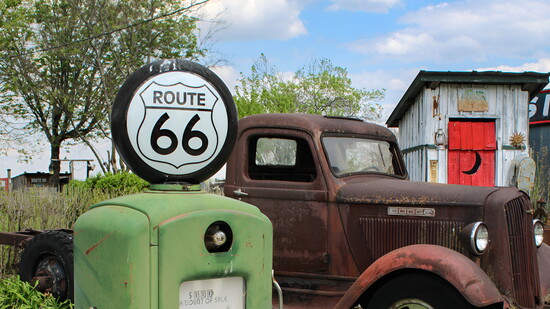
There’s something remarkable about Springfield, Missouri, a city that doesn’t just sit along the infamous Route 66; it helped birth it. Long before the neon signs and nostalgic road trips, full of photographs-turned-postcards and Americana playlists, there was a decision. A number: 66. And that number was decided in Springfield.
For author and historian Susan Croce Kelly, that origin story isn’t just a collection of trivia facts, it is the heartbeat of the road itself.
Kelly’s fascination with the road began during her childhood. Her mother was raised in southwest Missouri, and family stories painted Route 66 as something almost sacred. She remembers walking down the blacktop road with her mom and hearing her say, “This is the most famous road in the world.” That early imagery, paired with her own professional career that revolves around covering the Ozarks, eventually pulled her back into the orbit of the highway.
What she discovered was a rich history that had much more to offer than pure nostalgia.
In the early 20th century, America’s roads were fragmented and unreliable. States controlled their own road systems, often leaving travelers stranded at borders where roads simply didn’t connect. People became desperate for better roads and pushed for a unified highway system. That growing demand made the plea something the federal government could no longer ignore.
Enter Cyrus Avery, often called the “Father of Route 66.” Avery was part of a national effort to create standardized highways. His taskforce introduced numbered routes that would guide travelers clearly across state lines. Originally, the Chicago-to-Los Angeles route was slated to be Highway 60. But politics intervened.
That’s where Springfield comes into the story.
In April 1926, Avery and other officials who were gathered in Springfield set out to resolve the numbering dispute. After much debate about the number “60” and the possibility of using “62”, a telegram was sent from Avery and Missouri State Highway Engineer B.H. Piepmeier. In an effort to compromise, the group had searched for a “catchier” unused number and discovered “66”. By the end of May, a consensus had been reached.
On November 11, 1926, the name Route 66 was officially adopted.
Springfield wasn’t just along the road, it was the place where the road got its name. A name that would live on in history indefinitely.
That moment defines why the city celebrate its identity as the “Birthplace of Route 66.”
Author Michael Wallis, whose seminal book helped spark the modern Route 66 revival, describes the highway as something personal for many, especially Missourians.
Growing up near St. Louis, Route 66 shaped everything from family trips to fast drives that fed the adrenaline of youngsters.
Wallis sees Springfield as a vital link in the broader Route 66 narrative, not just historically, but culturally as well. He says that Springfield has a great remaining business route right through town and credits the stretch between St. Louis and the Ozarks as one of the best on the entire road.
That stretch tells a layered story of booming tourism in the 1950s, a decline after the rise of the interstate system, and now a global resurgence.
Historian Jim Hinkley frames it even more expansively, saying that Route 66 is the longest small town in America. This linear community connects places like Springfield with others across the country in a common, shared identity.
Hinkley emphasizes that Springfield wasn’t just present at the creation, it was instrumental in shaping the road’s early success. From political negotiations to promotional campaigns, the city helped transform Route 66 into something bigger than infrastructure; it became an experience.
That experience, in turn, reshaped local economy.
By the late 1930s, Route 66 carried massive traffic volumes. Businesses sprang up to meet demands, such as cafes, motor courts, and gas stations. These businesses turned Springfield into a thriving hub for travelers across the country.
Not only was it one of the earlier portions of the highway to be paved, it offered unique destinations such as America’s first drive thru, Red’s Giant Hamburger, established in 1947 by Sheldon “Red” Chaney.
It was transformative for economy and society, Hinkley says.
And yet, what makes Springfield’s role remarkable isn’t just its history, it’s its continuity.
Unlike many cities that lost their connection to Route 66 after the interstate era, Springfield has maintained a tangible relationship. The road still runs through it. The stories still live and thrive within it. And its identity has become one that is inseparable from the history of the road itself.
Wallis resists the idea that Route 66 belongs solely to the past. In fact, he says that he doesn’t even talk about it in past tense, citing that more than 85% of it can still be driven.
It is a living, breathing, piece of history that keeps Springfield relevant and an active participant in its next chapter. Because in Springfield, Route 66 wasn’t just born, and it’s not just remembered, it is continually shaping its culture as part of the longest small town in America.
"This is the most famous road in the whole world.”
The stories still live and thrive within it. And Springfield's identity has become one that is inseparable from the history of the infamous road itself.