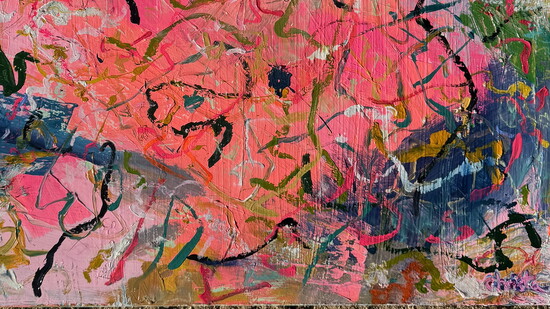
Pablo Picasso is often credited with observing, “Every child is an artist. The problem is how to remain an artist once he grows up.” It is an idea that resonates deeply with Christa Peyton, a self-taught contemporary artist whose “wildly vibrant” paintings suggest that perhaps the path toward creative freedom is not about learning more, but unlearning what adulthood has taught us.
Children create without first asking whether they are doing it correctly. A shape can become a person, a few marks a landscape. Color need not be logical, and beauty does not require explanation. Somewhere in growing up, however, instinct often gives way to rules, judgment and the desire to get things right.
Peyton’s evolving practice has become an exercise in reversing that process.
Her earlier paintings were recognizable landscapes, birds and botanicals rendered in a quiet, muted palette. Looking back, Peyton describes them simply as “safe.” Then, in 2024, something shifted. Painting on her back porch while listening to an Austin-in-the-’80s playlist, she reached for neon color and memories of the music, fashion, and visual energy of her childhood. Color became an early act of permission.
But freedom came incrementally. The bright paintings still held tightly to structure and clean edges. Over time, those boundaries began to fall away too. Peyton painted on loose canvas, sanded through layers and experimented with oil pastels, “adult crayons,” as she delightedly calls them. When circumstances required her to paint with her nondominant hand, even that became an opportunity to relinquish control and discover something unexpected.
There is something distinctly childlike in this way of working, not childish, but instinctive. Children rarely begin by wondering whether a drawing will be successful; they respond to the pleasure and possibility of making it. Peyton is finding her way back to that freedom, one self-imposed rule at a time. Curiosity before judgment, experimentation before outcome, and intuition before correctness. “I’m listening to my intuition more this year,” she says, describing the process of learning to trust herself and understand that doing so is okay.
Art, she says, means “complete freedom”—the ability to create without judging herself. It has also given her confidence and, importantly, a way of “honoring my inner child.”
Her painting Joyful Defiance gives that evolution a name. Peyton describes the work as the spirit of a child “finding her voice, bending rules, testing boundaries, and choosing joy over compliance.” Beneath its exuberance is something more personal: her own story emerging through abstraction, embedded in gesture, color, and marks.
For Peyton, reclaiming childhood joy is becoming larger than painting. She is writing a book, has written a song rooted in childhood memory, and is developing workshops centered on experimentation rather than prescribed outcomes. She wants participants to play with materials, make imperfect marks and rediscover an instinct adulthood may have quieted: “There’s no judging. There’s no rules.”
“I feel grateful that I’m in a position now to pass on ways for other people to express themselves,” she says.
Perhaps that is the creative potential Picasso’s observation asks us to preserve: not the ability to make art like a child, but the courage to create before asking permission.
Find Christa Peyton: christapeyton.com
In person: Vintage Comfort, Comfort, Texas
“Art means complete freedom—the ability to create without judging myself.”
“Peyton is finding her way back to the freedom of childhood, choosing curiosity before judgment, experimentation before outcome, and intuition before correctness.”