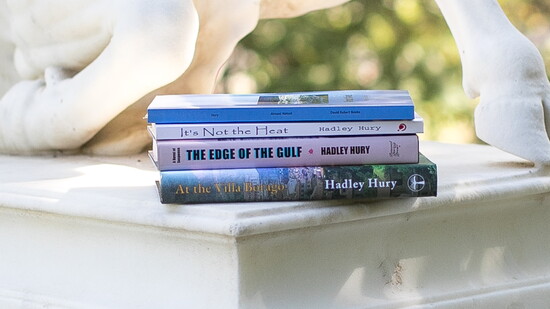
In At the Villa Borago, Hadley Hury’s newest novel, two worlds meet across oceans and eras—Florence and Memphis, love and loss, art and identity. The book unfolds with a sense of grace and intelligence that reflects not just the story’s characters but the man who created them. For Hury, a longtime Memphian, words have always been the way to make sense of the world—and to celebrate its complexities.
A teacher, critic and storyteller, Hury has spent decades examining how art and culture shape who we are. His writing has long reflected that sensibility, from his years as a film and theater critic for The Memphis Flyer to his essays for Memphis Magazine. “The reviews almost always considered the films not only in and of themselves but within their broader cultural context,” Hury recalls. “Encouragingly to me at the time, they gained a large and loyal following.” That curiosity about context—about how art mirrors life—remains at the center of his work.
His creative journey began in earnest after several years in nonprofit leadership roles. Though he wrote throughout college and graduate school, it wasn’t until his late thirties that he turned fully toward fiction. His first novel, The Edge of the Gulf, was published in 2003, followed by the short story collection It’s Not the Heat (2007) and the poetry volume Almost Naked (2018). Across genres, his hallmark is empathy—for the artist, the audience and the human condition.
With At the Villa Borago, Hury brings all his creative selves together: the teacher, the critic and the novelist. “Having a teacher leaning over one shoulder and a critic over the other has often been a challenge,” he says with a smile. “But with At the Villa Borago, all three of ‘us’ seemed to be working in harmony. I don’t know whether to chalk that up to maturity or sheer determination, but we were all rowing toward the same goal.”
Early readers have called the book “smart, fun and ultimately very moving.” Hury describes it as a character-driven novel, rich in humor and humanity. “I first formed the group of individual characters with whom I wanted to work,” he explains. “The settings are major characters in themselves. Roughly half the story is set in and near Florence, the other half in Memphis—with a few scenes in Nashville. These places, including the Villa Borago itself, have profound influence in these lives.”
For Hury, setting is more than backdrop—it’s identity. Memphis, in particular, runs deep through his work and worldview. “Memphis is a unique city, in both America and the world,” he says. “Because of its particular location—both geographically and in the history of our country—its story consists of promise and challenge, rich romance and harsh realities.” He speaks of the city’s “distinctive texture, tone and color,” and how its intersection of energies has long inspired artists. “We hear the story of who we are when we listen to the voices of the great Delta blues artists, Aretha, Elvis, Tina. And in the words of William Faulkner, Peter Taylor, Katori Hall and Tennessee Williams, we learn about the various roads that have brought us together here—and the vibrant strengths that can carry us forward.”
Although Hury lived for more than twenty years in four other very interesting cities, he says, “Memphis is my home. It’s not just another middle-sized American city relatively indistinguishable from its peers. It has distinctive historical and cultural dimensions, unique texture, tone and color.” In At the Villa Borago, those qualities infuse the story’s Memphis scenes with warmth and authenticity, grounding its broader themes of connection and change.
The novel’s characters, Hury says, live “on the cusp of a great cultural and social shift.” Rather than escaping the disorientation of our current times, he embraced it in the book’s creation. “The characters are learning and striving to be their best, most authentic selves, but they also believe in something larger than themselves.” The novel explores decency, honesty, and empathy as acts of quiet resistance. “It’s a love story, among other things,” he says, “but it came about as a way of dealing with the current historical moment by appreciating that life can be otherwise—that goodness itself is always ready and waiting for us to activate.”
Despite the novel’s depth, Hury infuses it with levity and joy. “Along with its serious explorations, the story is propelled by a lot of buoyancy and humor,” he says. Early readers have praised that balance: “Real substance. Real charm,” wrote one. Another said, “It evokes levels of serious thoughts and questions, but my primary takeaway is that I smiled throughout.”
That mix of intellect and warmth is signature Hury. His writing process reflects the same thoughtful rhythm. He writes six days a week, usually midday for three to four hours. At the Villa Borago took about ten months to complete. “Getting started can be daunting,” he admits. “It’s a little like that feeling we had as small children when we desperately wanted to be in the cold pool on a hot day, but cringed at the thought of that first jump.” Once immersed, he rarely struggles with writer’s block. When problems arise, he walks. “Talking development and scenes through out loud as I walk can bring fresh perspectives and objectivity,” he says. “My neighborhood probably wonders about the guy walking down the street alone, apparently engaged in full-out conversation with no discernible earpods.”
Hury’s lifelong devotion to words began early. “My father was a wonderful storyteller,” he recalls. “Then I met Dick and Jane and the Bobbsey Twins and the Hardy Boys and National Geographic and Tom Sawyer, and I never got off the road. Words led me into books, and books led me into life and the world.” One of his earliest literary memories still makes him laugh: at eight years old, inspired by a classroom lesson on ancient Egypt, he wrote his own “scroll” about the sun, tied it with a red ribbon and presented it to his mother’s bridge club. “They read it aloud and thanked me. I heard no laughter. Writers may, in some significant ways, be born, but they also need to get started—and they need at least a couple of important encouragers along the way.”
That sense of encouragement—and the belief that stories can illuminate and connect us—permeates At the Villa Borago. Like its author, the novel honors the past while embracing what’s possible. For Hury, writing remains both vocation and voyage. “The problem-solving,” he says, “is not only an essential part of writing—it can be one of the most invigorating.”
“Memphis is my home. It’s not just another middle-sized American city relatively indistinguishable from its peers. It has distinctive historical and cultural dimensions, unique texture, tone and color.”