While many kids spend their summer swimming or playing video games, a small group of Bridgewater middle schoolers spends its time programming Astrobee, a real NASA robot used aboard the International Space Station. Through Zero Robotics, a national STEM program created by MIT and NASA, these students join just 88 teams—nearly 800 kids—across the country in a challenge unlike anything they ever imagine: teaching a robot how to grow food in orbit.
What unfolds isn’t simply a coding project. It becomes a story of curiosity, collaboration and what happens when young learners realize they can solve real problems.
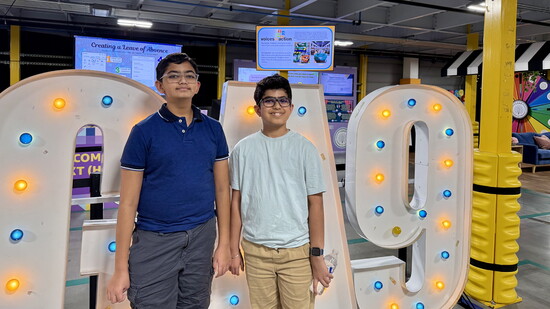
Their journey begins months earlier at the district’s annual STEAM Expo, where Bridgewater School seventh graders Armaan Chopra and Araansh Tiwari introduce BirdBudz (www.birdbudz.com), an AI-powered tool created to detect early signs of bird flu in wild birds. The project is thoughtful, creative and rooted in a desire to help wildlife. It sparks conversations across the Expo floor and opens the door to something bigger. BirdBudz shows the students what AI can accomplish on Earth. Zero Robotics shows them how far their ideas can reach—literally.
So when the opportunity to join the MIT/NASA summer challenge appears, they don’t hesitate.
Over the next five weeks, the students learn to guide Astrobee through a simulated space station environment as it plants seeds, refills water and harvests crops—all in a frantic four-minute window while competing against another team’s robot. The challenge demands far more than writing lines of code. Timing matters. Physics matters. Strategy matters. A plant can die if it isn’t watered twice within 60 seconds. Harvesting too early earns zero points. Astrobee can enter only certain zones at specific times, turning every second into a strategic decision.
Most students start with no programming experience. Concepts like variables, arrays and functions are complete mysteries. So they begin with games—acting out robot movements, breaking down instructions step by step and even learning coding logic through a peanut-butter-and-jelly challenge. As one team member says, “We don’t know any coding at first. But the games make everything make sense. Suddenly, we aren’t just kids—we’re robot programmers.”
Watching their robot move, hesitate, adjust and sometimes bump into a wall teaches them more about engineering than any worksheet ever can.
The team itself is a vibrant mix of learners: Chopra, Anitej Das, Shubham Chouhan, Ahaan Behera and Srish Sankaran, guided by Sanika Jaiswal, a Bridgewater ninth grader who serves as their mentor. Behind the scenes, parent volunteers, including Deepika Chopra, help create the space and structure the students need to explore freely and confidently.
One of the most transformative elements of the experience is the thoughtful use of AI. Zero Robotics encourages students to use AI tools responsibly, and the Bridgewater group embraces that guidance with maturity. They use AI not to replace thinking but to expand it. When a physics concept feels confusing, AI breaks it down in simple language. When a bug slows progress, AI helps them debug. When NASA’s technical instructions feel overwhelming, AI translates them into something middle schoolers can understand.
“If we don’t understand something, AI explains it in kid language and then we figure out how to fix it,” one student says. AI becomes a partner in learning, not a shortcut.
The heart of the summer, though, is the energy inside every session. Their whiteboards fill with diagrams and timing sequences. Their conversations buzz with “What if we try this?” and “Let’s test that.” Kids who once doubt their coding abilities begin taking the lead in strategy discussions. Students who are quiet in class find confidence in collaboration. Parents notice dinner-table conversations suddenly shifting to vectors, microgravity and optimization.
As Jaiswal reflects, “Mentoring the team this summer is an amazing experience for me as well. I learn so much alongside the kids and love watching them grow from beginners to confident problem-solvers. Seeing their excitement as they test ideas, refine strategies and work together is truly inspiring. I’m grateful I get to be part of their journey.”
Their journey captures something essential about the Bridgewater community—its belief in young minds and its commitment to giving kids opportunities to stretch, explore and discover. These students aren’t just learning coding or robotics. They’re learning to see themselves as creators, scientists and innovators. They’re learning that AI can be a tool for possibility, not pressure. And they’re learning that world-changing ideas often start small—sometimes even at a kitchen table.
Now that the challenge wraps, one thing is already clear: This summer is only the beginning. These students step into a future where AI, robotics and space exploration shape industries, opportunities and discoveries. And thanks to one Expo project and one unforgettable NASA challenge, Bridgewater’s young innovators are already on their way.
Their story is a reminder that when you give kids real tools, real trust and real challenges—they don’t just learn. They innovate. They dream bigger. And they reach for the stars.