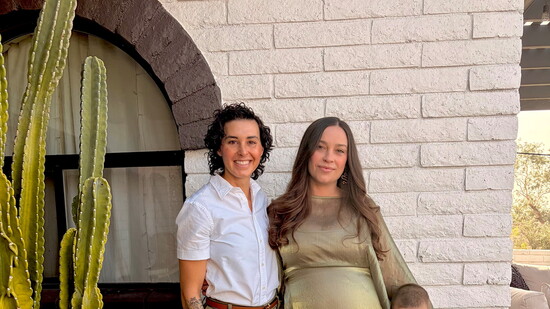
In May 2023, Brittany Barden was starting over in the best possible way. She had a new role at City of Hope Cancer Center Arizona, a young son named Beau, and a life that was finally coming together.
Then, on Beau’s birthday, she found a lump under her arm during a breast self-exam. Days later, a doctor told her she had stage II invasive ductal carcinoma.
Brittany was 36, and a single mother with no family history of breast cancer.
When genetic testing came back negative for a hereditary cause, her cancer was deemed sporadic, one of the many breast cancers that arrive without warning and without a family history to explain them. She turned to City of Hope Cancer Center Arizona, part of one of the nation’s leading cancer research and treatment organizations, confident she had found the right place.
Her care team included Cynthia Lynch, M.D., oncologist and medical director of the Breast Program at City of Hope Arizona; Marnee Spierer, M.D., chief of radiation oncology; and breast surgeon Raquel Prati, M.D. Together, they developed a plan tailored to her diagnosis: a lumpectomy, a clear sentinel lymph node biopsy and 28 radiation treatments. Because her tumor was hormone receptor-positive, she avoided chemotherapy and continues taking tamoxifen as endocrine therapy.
This Breast Cancer Awareness Month, Brittany’s story underscores a shift City of Hope physicians are seeing nationwide: more women are being diagnosed earlier in life.
Linda Ling-Ying Liu, M.D., a board-certified breast cancer surgeon at City of Hope Cancer Care Scottsdale, City of Hope Cancer Care Gilbert and City of Hope Cancer Center Arizona, encourages women to talk with their own physician about the right screening schedule for them.
“Mammograms are a critical tool to help identify breast cancer, the most prevalent type of cancer in Arizona, at earlier stages, when treatments are more likely to be successful," she says.
That depth defines City of Hope, where more than 2,000 physicians, scientists and researchers focus on cancer. Its record of superior outcomes gave Brittany confidence her team could handle whatever came next.
For Brittany, comfort also came from those who made sure she never faced treatment alone. Her parents came to Phoenix to help, while her friend Megan flew to Arizona and stayed by her side through appointments and difficult days.
Equally as important, Brittany's City of Hope team treated more than her cancer. They answered her questions, asked how she was coping as a mother while continuing to work and connected her with resources throughout treatment. Early on, they also introduced her to Cancer Fighters, a community of patients, caregivers, friends and family united by one belief: no one should face cancer alone.
During treatment, Brittany’s friendship with Megan became something more. By the time treatment ended, they were building a life together.
"Being diagnosed with cancer doesn’t define your life,” says Brittany. “We have to figure out how to live with cancer. Understand the diagnosis. Learn the next steps and stay in motion. And sometimes, like in my case, it leads life to change in wonderful ways."
She shares her story now because breast cancer does not have a timeline. It arrived on her son’s birthday, without warning.
City of Hope Cancer Center Arizona is located in Goodyear, with locations in North Phoenix, North Scottsdale, Gilbert and a new location in Prescott.
cityofhope.org/Arizona