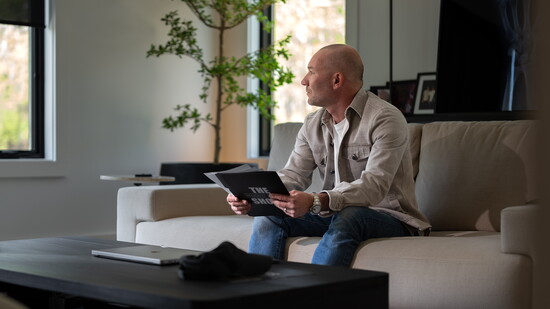
Fourteen years working in places he still can't fully talk about. Now Shawn Ryan is building something for the rest of us — one honest conversation at a time.
If you don't already know who Shawn Ryan is, here's the short version: he runs one of the biggest interview podcasts in the country. The Shawn Ryan Show has sat him across from a Vice President of Taiwan during a moment of real geopolitical fragility, and across from a hacker whose findings knocked $28 billion off a public company's market cap. He's also become a privacy entrepreneur, building a security app called Glacier, and a leading voice for veterans navigating life after service.
What you may not know is where it started: fourteen years as a Navy SEAL and CIA contractor, running combat operations most of us will never hear about.
I was honored to sit down with Shawn for our November issue, the one where we honor the people who served. Temecula has a tremendous veteran community. Between Camp Pendleton up the road and how many veterans land here to retire and build businesses, we have our share of that story too. It's why this felt like the right conversation for this month.
Fourteen years, then nothing
When Ryan's time in the SEAL teams and as a CIA contractor ended, it ended the way it does for a lot of operators: abruptly, without a plan for what comes next.
"You're operating in combat as a Navy SEAL, then contracting for the CIA — working at a level that's basically professional-athlete-equivalent," he told me. "There's just not another level to go to. And then you leave, and it's gone. Your identity gets wrapped up in that. It becomes who you are. You go from a world where everybody knows who you are — and then you jump into civilian life where you can't even talk about ninety percent of what you did. It's a huge hit to your identity. You've got to start over."
The trap, he says, is trying to fix that by staying in the same world — a badge instead of a uniform. "It's never going to be like the hype you felt on a target in combat. Guys want to stay in the genre, but the real challenge is getting out of it — and finding out who you are as a person again."
For Ryan, what was on the other side of that turned out to be a camera.
Five hundred dollars and a crash course
The origin story of The Shawn Ryan Show isn't glamorous. Ryan was training private clients — Keanu Reeves among them — and getting bored. So he called the crew that used to film him and gave them a deadline. "I want to hire you guys to come out — teach me what equipment to buy, teach me how to film, teach me how to edit. We've got to do this in four days, because that's all I can afford."
His first guest was Mike Glover, a fellow Special Forces veteran. The goal wasn't views. "I wanted to correct history — document it the way it actually happened, from the people who were actually there, not some talking head on the news," Ryan says. "I wanted to give people a peek behind the curtain — the sacrifices, the trauma — so when they see the angry, loose-cannon veteran, maybe they have a little insight into why."
That decision turned into one of the most meaningful things Ryan has built. The show has become a real pipeline for veterans transitioning into entrepreneurship, and it's helped raise more than a million dollars for veteran causes. He's also a vocal advocate for natural medicinal-assisted PTSD and TBI research, which he argues deserves a real hearing instead of a stigma. Entrepreneurship, he says, was part of what pulled him and Glover out of the cycle so many veterans fall into. "What got us out of it, for a lot of us, was entrepreneurship. I liked business, I excelled at it, and building something meaningful became my primary focus."
The interviews that moved markets and nations
Two episodes come up when Ryan talks about the weight of what he's built. The first is Ryan Montgomery, a hacker who exposes predators targeting kids on gaming platforms. "He was this hacker, maybe 85 pounds, self-sabotaging, extreme anxiety — and nobody was talking to this guy," Ryan says. "I brought him on, and that's when I found out he was a recovered heroin addict, a former black-hat hacker turned white-hat, who's made it his mission to save kids."
When Montgomery laid out what was happening on Roblox and Minecraft on Ryan's show, the fallout was fast. "We were the first ones to talk about it on a big platform," Ryan says. "Since that episode released, they've had twenty-eight billion dollars lost in their stock. It went down forty-four-point-eight percent, and you can see the sharp decline start the day that episode came out." He and Montgomery are now building a protection app for parents.
The second is his interview with Hsiao Bi-khim, the sitting Vice President of Taiwan — the one Ryan calls the most nerve-wracking of his career. "That was my dream interview, one I'd been trying to get for a long time," he says. "When it came to research time and I realized how fragile that situation actually is, it scared the hell out of me. I have to be 100% accurate on this." He took the backlash that came with it and didn't flinch.
Building Glacier
The app Ryan's building on the tech side is called Glacier, a privacy and security tool built with former intelligence professionals. "I'm not a techie, so I wanted this to be as simple as we could possibly make it," he says of the app's secure DNS feature, its standout tool alongside a built-in VPN and private burner numbers. "You open the app, you click connect, you close the app, and you never have to open it again." The pitch isn't paranoia — everyday apps quietly harvest more of your life than most people realize, and there should be an easy way to shut the door.
A message for November
I closed our conversation by asking Shawn what he'd say directly to the people still in it, and the ones just getting out.
"Start getting ahead of all the stuff you hear about — the post-traumatic stress, the traumatic brain injury," he said. "There's all these different avenues now for healing, to keep from spiraling into addiction, alcoholism, and other harmful
behaviors." If you can get ahead of it, your chances of surviving that transition are a lot better."
Then he said the thing that matters most for anyone still afraid to say it out loud: "That stigma has been demolished. The most badass people the military's ever produced are out here saying, this is what happened, and this is how bad it got. There's no need to be ashamed. It's okay to say you're not okay."
This November, as we honor the veterans in our own community — the neighbors, the coaches, the business owners who served before they were any of those things — Shawn Ryan's story is a reminder of what's possible on the other side of that transition: not a return to who you were, but something new, built on purpose, with the same discipline that got you through the first mission.
The Shawn Ryan Show is available wherever you get your podcasts. Learn more about Glacier at theglacierapp.com.
"You go from a world where everybody knows who you are — and then you jump into civilian life where you can't even talk about ninety percent of what you did. It's a huge hit to your identity. You've got to start over."
"That stigma has been demolished. The most badass people the military's ever produced are out here saying, this is what happened, and this is how bad it got. There's no need to be ashamed. It's okay to say you're not okay."